


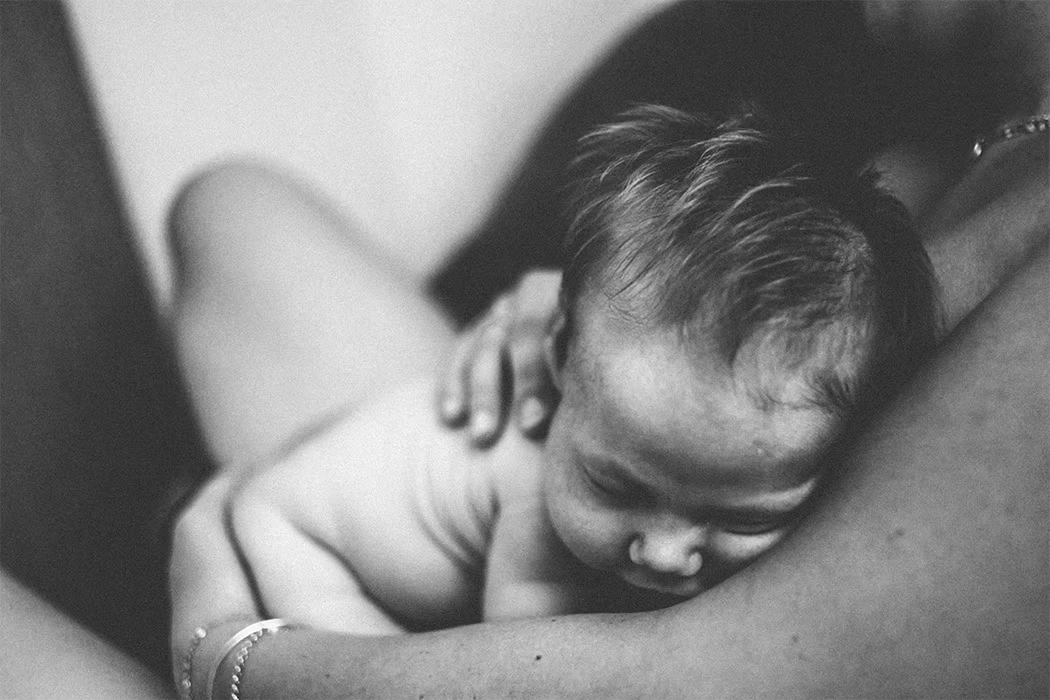
The desire for a less medicalized birth is currently gaining significant momentum. Many mothers-to-be wish to give birth in an environment more conducive to the physiological process. Let’s explore the different options available in France.
Birth Centers
In France, birth centers first appeared in 2016. Managed by midwives, these centers are unique because they are always located in immediate proximity to a maternity ward, allowing for a rapid transfer if necessary.
Designed for physiological birth projects, birth centers do not administer epidurals. They are set up to foster an intimate and natural environment, featuring equipment such as bathtubs, suspension ropes, hot water bottles, and Pilates balls, creating an atmosphere favorable to natural childbirth. Noise and light are also kept to a minimum to avoid disturbing the natural birthing process.
As a “de-medicalized” place of birth, the birth center imposes certain conditions to ensure the safety of both mother and baby:
- Low-risk, singleton pregnancy.
- Birth plan without an epidural.
- Birth scheduled between 37 and 41 weeks of gestation.
- Baby in a head-down (cephalic) position.
- Absence of pathologies such as gestational diabetes or pre-eclampsia.
- Geographic proximity: home must be within 40 minutes of the birth center.
If giving birth in a birth center appeals to you, don’t delay in registering. Unfortunately, there are only eight birth centers in France as of 2024. Spots are “expensive” in every sense; these structures do not receive the same government subsidies as public maternity hospitals, resulting in an average out-of-pocket cost of €1,200.
Technical Platforms
The technical platform offers another interesting alternative for a natural birth plan. This refers to a delivery room located within a hospital structure that is made available to independent (private) midwives. To access this, you must be followed by a midwife who will rent the room for your delivery. The technical platform thus combines hospital safety with the intimacy of an independent structure.
Despite its somewhat clinical name, the technical platform offers a soft, intimate atmosphere similar to a room at home. During a delivery here, you will be in a small group, as only your birth partner and your midwife will be present.
This option offers numerous advantages: you know everyone present, enjoy an intimate environment, can eat and drink as you wish, choose your preferred positions, wear the clothing of your choice (like a great seamless bra), and ensure total respect for the physiology of birth.
The cost of a technical platform birth varies between €500 and €900, covering the midwife’s on-call fee and the room rental. These fees are not covered by Social Security, but some private insurance providers may reimburse them.
The Natural Birthing Room
In response to the growing demand for “natural” births, many maternity hospitals have created more physiological rooms called “salles nature.” Located within the hospitals themselves, these rooms offer a warmer environment that looks more like a bedroom than a hospital room.
They are furnished with non-medical equipment such as sofas, large beds, birth balls, cushions, or suspension ropes. Some even feature large bathtubs for relaxation. Everything is designed to help the mother-to-be enter her “bubble,” which is essential for optimal hormone secretion.
A major advantage is that these rooms are integrated into the hospital. This allows you to benefit from a physiological environment while retaining the option to change your mind and request an epidural. In such cases, transferring to a standard delivery room is very easy.
The only downside is that they are still quite rare, and demand often exceeds supply. There is no guarantee one will be available when you arrive. However, it is often possible to adapt a “classic” delivery room to make it more physiological (balls, mats, lowered blinds, dimmed lights, etc.).
Regarding costs, since these rooms are part of the hospital structure, they cost no more than a standard delivery.
Home Birth
Finally, the last option is home birth. In France, this practice is legal but not governed by specific legislation. This lack of harmonized directives poses challenges for midwives, such as the difficulty of finding insurance to cover their practice.
Since Covid-19, the number of home births has increased annually, though it remains marginal (less than 1% of births in France). More than any other location, giving birth at home requires prerequisites to ensure maximum safety:
- Finding a midwife: In 2024, the APAAD listed 107 midwives practicing home births.
- Low-risk criteria: The pregnancy must be low-risk, and the home must be within 30–45 minutes of a maternity hospital.
- Rigorous follow-up: Care must comply with WHO and HAS (French National Authority for Health) recommendations.
- Transfer plan: A plan for hospital transfer in case of complications must be in place.
Mothers who choose home birth praise the benefits of birthing in a familiar, reassuring environment conducive to the “letting go” necessary during labor.
Conclusion : The availability of physiological birthing options is growing in France. It is important to remember that no option is inherently better than another. What matters is that your choices and desires are heard, respected, and made possible. I wish you the most beautiful of births.
Armelle is a doula and the author of the website madre.fr, where she offers bodily exploration to help women regain confidence in their bodies and better understand the physiology of childbirth.